
New requirements for the psychosocial work environment: Why dialogue matters more than ever

Eirin Eriksen Horvei
October 14, 2026


The words are used interchangeably, and probably with different meanings. I have long wanted to tidy up these terms – simplify and sort them.
In my experience, the words good and positive are often used about feedback intended to confirm something good: a pat on the back, a thumbs up or a “well done!”. Feedback that says “what you did there was really good!”
And as far as I understand, the words constructive, critical, negative or bad are often used about feedback intended to adjust or correct – to point out something that isn't working well enough, something that could be better, or something that is, frankly, not good enough.
How about simplifying this picture by dealing with just two types of feedback: good and bad? Then we can let the adjective (good, constructive, negative, bad, positive, corrective, etc.) refer directly to the noun behind it – that is, to the word feedback. Good feedback can then be read as feedback that is given in a good way – a way that provides meaningful information, is useful and helpful, and can lead to change, development and growth.
Bad feedback is feedback given in such a way that it is unclear, unfounded, incomplete, hard to understand or completely empty. It can lead to uncertainty and frustration, and help damage relationships. Some such feedback may also be given with bad intentions: said to hurt or to assert oneself?
So-called ‘positive feedback’ (“Well done!”) doesn't have to be good – it can come across as vague and not very credible if it isn't given in a good way with enough information. It can create uncertainty if you don't understand what is meant (Øyestad, 2004). So-called ‘negative feedback’, on the other hand, can be good – it can be given in an orderly, informative and objective way that gets an important message across clearly and creates clarity, understanding and learning.
With this, I would like to introduce a new meaning: Good feedback is of good quality: it is intended to help you get better, and is presented in a way that gives you useful information about yourself! In other words, good feedback should be honest, justified, orderly, useful, expressed unambiguously and intended to give you something useful. This is constructive and positive.
In the same way, feedback is bad if it is unclear, unspecific, ambiguous, incomplete or not given with the intention of helping you succeed – even if the intention was to confirm something good or positive.
It can be difficult to give feedback. Especially if the feedback is about something that can or should (or even must!) be improved or changed. It is demanding because most people want to be liked, and it can be painful to give input that could potentially hurt, upset or provoke the person receiving the feedback. Few of us want to say something that might make others sad.
It can be difficult to receive feedback too. As the recipient of feedback, you are vulnerable, and you may of course disagree, be disappointed, hurt, sad or angry. These are emotions most people find demanding to handle, especially when standing face to face with the person giving the feedback. As the recipient, you risk the feedback feeling like “a blow below the belt”, and it can affect your self-esteem.
Even so – feedback is smart! It is useful to know something about how you are perceived. It is precisely on that basis that you can grow and develop as a person.
Feedback is important – both on a personal, individual level and for businesses and organisations. Feedback can create insight, and important adjustments or bigger changes can grow out of it.
In the 1950s, Joseph Luft and Harrington Ingham developed a psychological model to characterise different aspects of communication. The model describes how the ability to be open and clear, and to listen to feedback, is fundamental to forming a picture of how you are perceived by others. It distinguishes between what I know about myself and how others perceive me, and not least, it shows that these are not necessarily the same picture. The model clearly shows that there is something others know about me that I don't know myself. Luft and Ingham call this – descriptively enough – the ‘blind spot’.
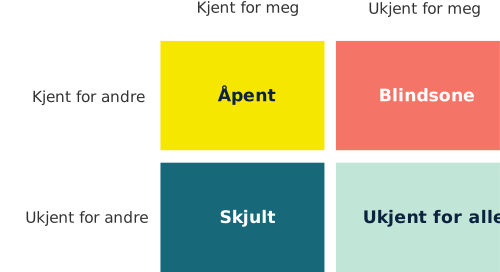
Feedback from those around me can provide important insight about myself. How I affect my surroundings can be very useful to know – at least if I want to make myself understood.
A feedback culture goes hand in hand with a culture of learning. A learning organisational culture promotes growth and development, and is characterised by, among other things, a low threshold for giving and receiving feedback. To have a good feedback culture, as in learning organisations, there must be a high degree of psychological safety and room to learn from mistakes.
How do you build a feedback culture? Start by working on psychological safety in the organisation, practise giving and receiving feedback, and focus on fostering a culture of learning.
When giving good, constructive feedback – feedback that can be about something I have done well or something I haven't done well – it should be characterised by being given with good intentions and in an orderly way.
I would like to introduce you to a model for ‘structured feedback’ that works very well. This is a way of giving feedback that does not rely on interpretation, which means the feedback is often perceived as more neutral and constructive by the person receiving it. Structured feedback provides a good starting point for dialogue instead of discussion, which is far more useful for promoting learning and development.
With structured feedback, the feedback relates directly to what has been experienced, and emphasises what you think about what you have experienced, not opinions you attribute to the person you are giving feedback to. Structured feedback always starts by referring to what you have seen and/or heard, and then links this to how it has affected you (what you thought, felt, wondered about, how you reacted, etc.). Finally, you can suggest an improvement or change.
“I saw that you were looking out of the window while I was talking to you, and I wondered whether you weren't engaged in the topic I was talking about. I would suggest that you meet my gaze more often and look at me when I'm talking to you – that way you can show that you are interested.”

Be orderly when distinguishing between ‘one’ and ‘many’: have you noticed that feedback tends to have unclear recipients? If Ola often arrives late for meetings, the manager might say at a department meeting: “it's not OK to be late for meetings! In future, I want everyone to be on time”. Such a message affects everyone at the meeting: those who are always on time feel unfairly treated by being told off about something that doesn't concern them, and Ola might think: “clearly I'm not the only one who's late. Since my manager is raising this at the department meeting, it probably applies to most people in the department”. And so he doesn't feel the feedback is aimed at him, and carries on as before.
Similarly, there is a tendency for feedback that concerns many people to be given to individuals. When the shared kitchen at work is messy, people talk in the corridor, one to one, about how “someone” needs to tidy up. Here, an all-staff meeting to agree on shared kitchen routines might be more appropriate.
Language is an important tool for communicating. It can be a razor-sharp tool, but sometimes also quite blunt. The wording makes all the difference. To be clear, I need to practise distinguishing between you and me. When all is said and done, I know very little about you – the information I have about you comes from my own interpretations, that is, from my own head or heart, consciously or unconsciously. I take in information through my senses, through what I see and hear, and I interpret. The brain is a master at creating meaning out of chaos, and it works regardless of whether it has been asked to. If it picks up something that “doesn't add up”, it immediately starts looking for meaning and explanation. At worst, this can go very wrong! “I see that you're frowning – you're sceptical about what I'm saying.” My brain interprets that you are sceptical. Perhaps the real situation is that your contact lenses are irritating and bothering you so that you squint and frown, and therefore you look sceptical to me. Ask and check – have I understood you correctly?
Feel free to put into words what your observations do to you: “When I see you doing that, I think that…” This makes it clear what you are observing and what you are interpreting/thinking. On that basis, you can give feedback as a suggestion: “Next time, I suggest that you…”
If you have clear opinions, impressions or assumptions about the other person, it can be orderly to put them on the table. Start by putting into words what you yourself think, and then ask whether the person recognises themselves in it.
If possible, give the feedback straight away. Then it is fresh in both parties' minds. It is easier to describe both what you saw and heard, and how it affected you. For the person receiving the feedback, it is easier to remember what happened, and what intentions actually were (or weren't) behind the incident.
I assume that you want to learn and develop, and that you therefore also want to increase your insight into yourself and how you come across to others – to explore the ‘blind spot’.
Then feedback is like a gift – a gift that can provide insight, clear up misunderstandings and promote learning. A gift you can choose to unwrap and examine with curiosity. A gift you can choose to use or discard.
And remember: once the gift has been handed over, your job is done, the task completed. You cannot order anyone to like it or use it. How this gift is received or used is no longer your responsibility, but the recipient's.
To you who are lucky enough to receive such a gift as honest, structured feedback: take good care of it; unwrap it carefully and examine thoroughly what it contains – it may be something useful to try out or explore, and it may be valuable information that helps you grow and become a better version of yourself – who knows?



